Optimal tissue
composition with Affinity®
The closest choice to native amniotic membrane
Never dehydrated or frozen, Affinity uses a gentle hypothermic* storage method called AlloFresh™ that preserves the product in its fresh state. In analytical testing, Affinity has been shown to retain its native tissue characteristics to support use as a protective barrier1,2:
Viable cells—including epithelial cells and fibroblasts1,3
Native extracellular matrix (ECM) structure—with multiple ECM proteins, including collagen types I, III, V, VI, and hyaluronic acid1,3,5
The spongy layer—an abundant source of proteoglycans, glycoproteins, and hyaluronic acid1,6

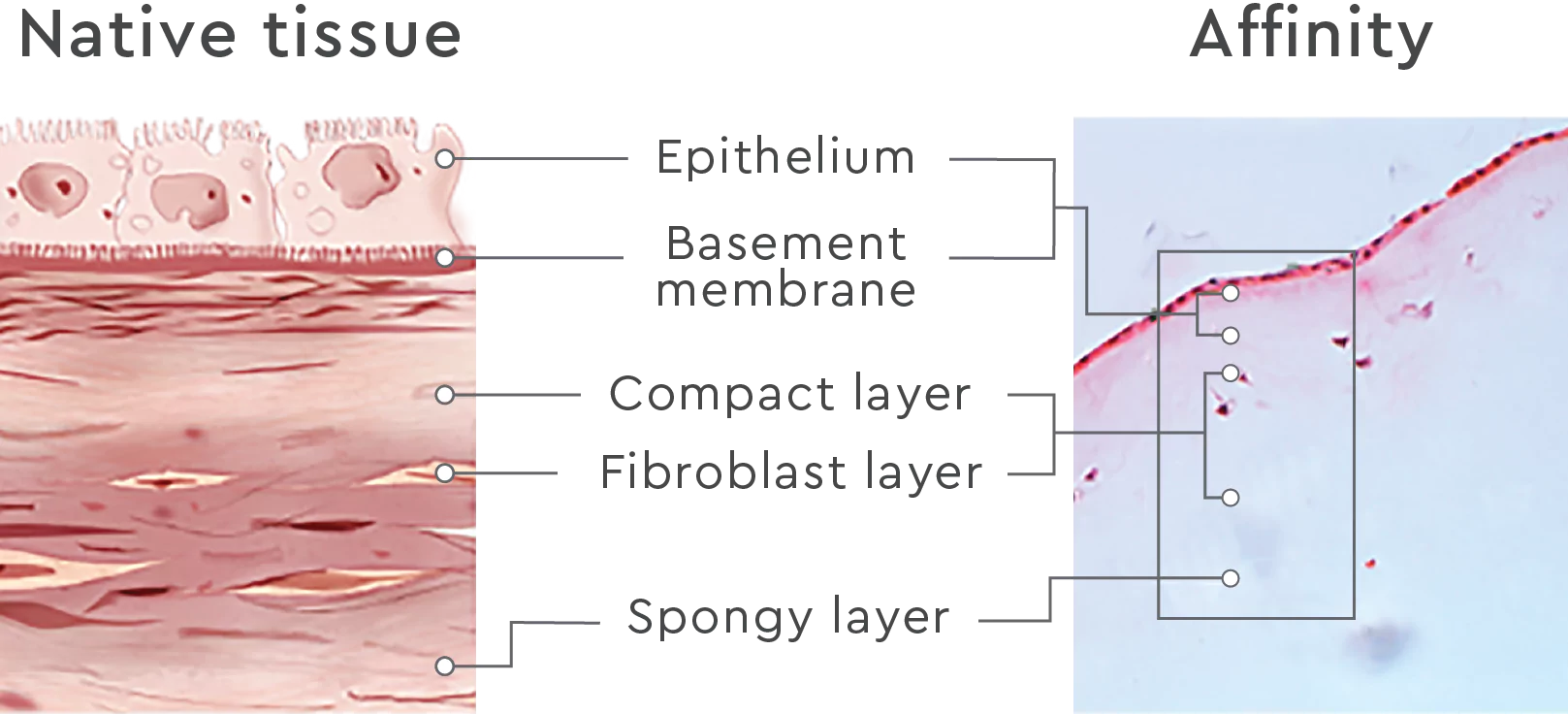
Discover the native structure of Affinity
Learn about AlloFresh, the hypothermic storage method that is used to preserve Affinity, or talk to an Organogenesis Tissue Regeneration Specialist about the only fresh amniotic membrane human tissue product on the market
Please refer to the Affinity instructions for use for usage and safety information.
REFERENCES:
- McQuilling JP, et al. Int Wound J. 2017;14(6):993-1005.
- Data on file. DR-0005. Organogenesis Inc.
- Niknejad H, et al. Eur Cells Mater. 2008;15:88-99.
- Data on file. DR-0007. Organogenesis Inc.
- Mamede AC, et al. Cell Tissue Res. 2012;349(2):447-458.
- Ghatak S, et al. Int J Cell Biol. 2015;2015:834893.